Smart Pointers in Modern C++
A practical guide to modern C++ smart pointers — why they replaced manual new/delete, how unique_ptr, shared_ptr, and weak_ptr each work, and when to reach for which one.
For decades, C++ memory management meant pairing every new with a delete — and hoping you never forgot one, never deleted twice, and never left a pointer dangling after the memory was freed. Smart pointers, introduced properly with C++11, largely ended that manual bookkeeping.
The Problem They Solve
cppvoid oldWay() { int* data = new int(42); // ... if an exception is thrown here, or you forget delete below, // this memory is leaked forever ... delete data; }
Every manual new/delete pair is a place a memory leak, a double-free, or a dangling pointer can sneak in — especially once exceptions and early returns are involved. Smart pointers apply RAII (see the constructors/destructors post) to memory itself: the object's destructor automatically frees the memory, so there's no manual delete to forget.
unique_ptr — Exclusive Ownership
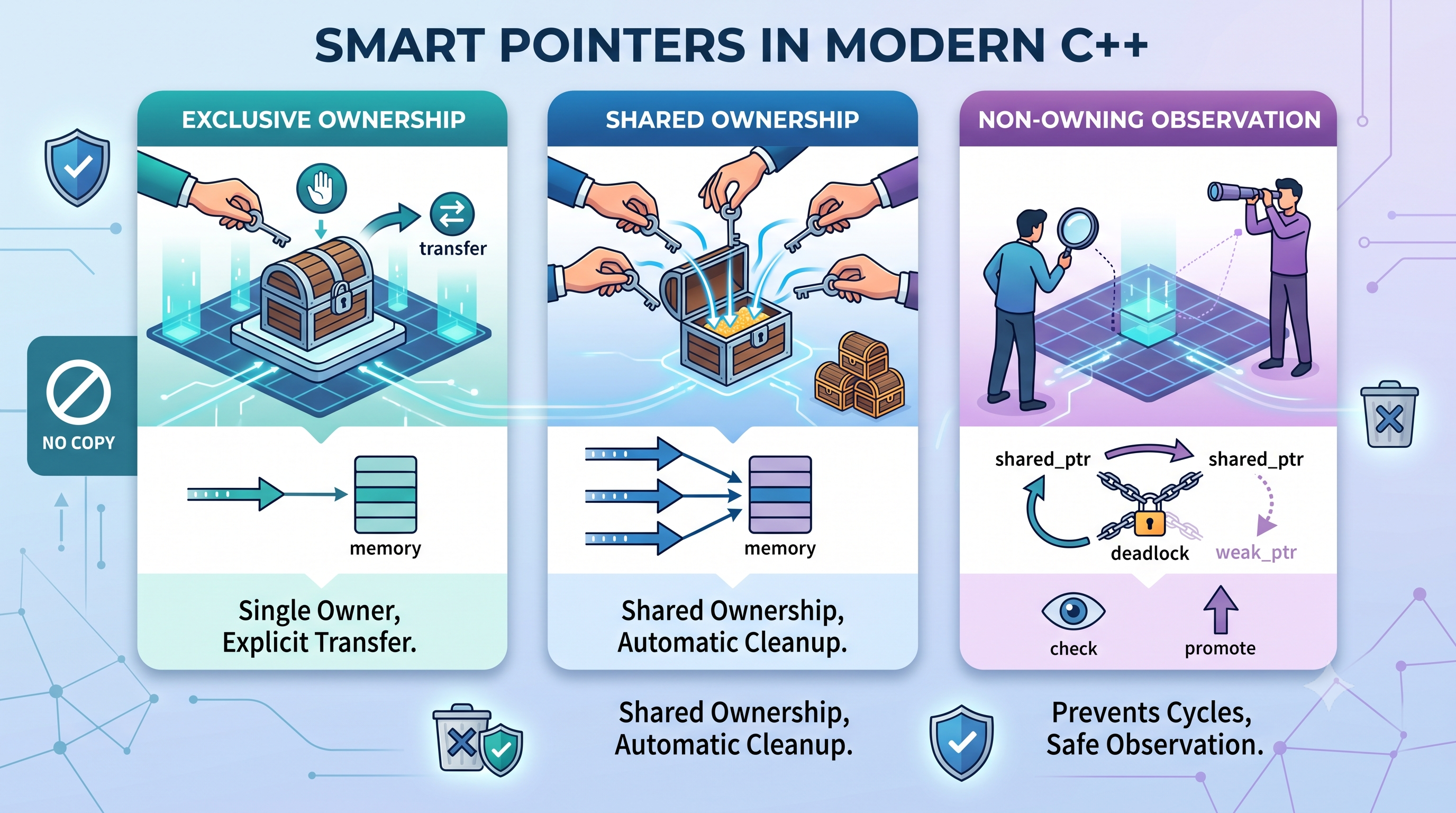
std::unique_ptr owns its memory exclusively. No two unique_ptrs can point to the same object — ownership can be transferred, but never shared.
cpp#include <memory> std::unique_ptr<int> ptr = std::make_unique<int>(42); std::cout << *ptr; // 42 // std::unique_ptr<int> ptr2 = ptr; // compile error — can't copy std::unique_ptr<int> ptr2 = std::move(ptr); // ownership transferred; ptr is now empty
When ptr2 goes out of scope, the memory is freed automatically — no delete needed anywhere. This should be your default choice whenever an object has one clear owner.
shared_ptr — Shared Ownership
std::shared_ptr allows multiple pointers to jointly own the same object, using an internal reference count. The memory is only freed once the last shared_ptr pointing to it is destroyed.
cppstd::shared_ptr<int> a = std::make_shared<int>(100); std::shared_ptr<int> b = a; // both now share ownership; ref count = 2 std::cout << a.use_count(); // 2
Use this when an object genuinely needs multiple independent owners — for example, a resource shared across several parts of a program where no single part is clearly responsible for cleanup.
weak_ptr — Observing Without Owning
std::weak_ptr points to an object managed by a shared_ptr without increasing the reference count. It exists to solve one specific problem: circular references.
cppstruct Node { std::shared_ptr<Node> next; std::weak_ptr<Node> prev; // weak — breaks the cycle };
If two objects hold shared_ptrs to each other, their reference counts never reach zero, and neither is ever freed — a memory leak despite using "smart" pointers. Making one direction weak_ptr breaks that cycle, since it doesn't count toward ownership.
cppstd::shared_ptr<int> sp = std::make_shared<int>(10); std::weak_ptr<int> wp = sp; if (auto locked = wp.lock()) { // safely check if it's still alive std::cout << *locked; }
Choosing the Right One
| Pointer | Ownership | Use when |
|---|---|---|
unique_ptr | Exclusive | One clear owner — this should be your default |
shared_ptr | Shared, reference-counted | Multiple parts of the program genuinely co-own the resource |
weak_ptr | None (observes only) | You need a reference to a shared_ptr-managed object without affecting its lifetime, especially to break cycles |
A common rule of thumb: reach for unique_ptr by default, upgrade to shared_ptr only when shared ownership is a real requirement, and use weak_ptr specifically to break cycles or to safely check whether a shared object still exists.
The Takeaway
Smart pointers turn memory management from a manual discipline into something the type system enforces for you. unique_ptr gives you safe exclusive ownership at zero extra cost, shared_ptr handles genuinely shared resources with automatic cleanup, and weak_ptr quietly solves the one problem shared ownership creates on its own — reference cycles that would otherwise leak forever.